
Configuration
Windows quick start
Route your first Windows application through a proxy in five minutes: add a proxy server, create a rule, check the result. Includes a map of the full Windows guide.
Windows quick start
This page gets one application routed through a proxy in about five minutes, then points you to the page for every feature. If you have not installed ProxyBridge yet, start with Install on Windows.
ProxyBridge only changes where an application's traffic goes. It is not a VPN and does not hide your IP address. What happens to the traffic afterwards depends on the proxy you point it at.
How the pieces fit together
| Piece | What it is |
|---|---|
| Proxy server | A SOCKS5 or HTTP proxy that ProxyBridge sends traffic to, for example 127.0.0.1:1080 |
| Rule | "When this application connects (to these hosts and ports, over TCP and/or UDP), do this action" |
| Action | Proxy (send through one of your proxy servers), Direct (leave alone) or Block (refuse the connection) |
| Profile | A saved set of proxy servers, rules and settings you can switch, export and share |
Anything that matches no rule goes out directly, exactly as if ProxyBridge were not running.
1. Add a proxy server
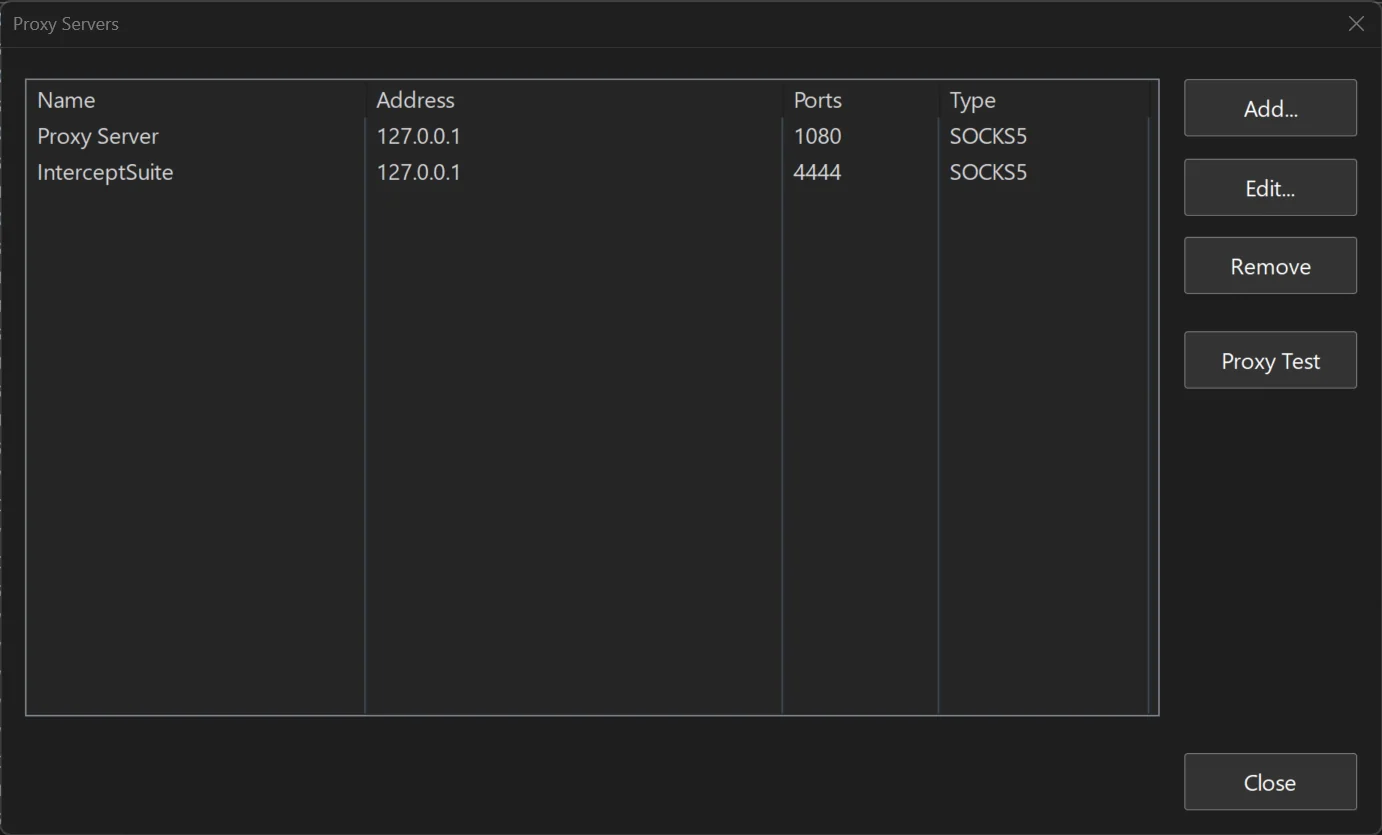
- Open ProxyBridge and choose Proxy > Proxy Settings...
- Click Add...
- Give it a Name, enter the Address and Port, and choose the Protocol:
SOCKS5orHTTP. - If the proxy needs a login, tick Enable under Authentication and enter the username and password.
- Click OK, then select the proxy in the list and click Proxy Test to check that it works.
Details, including DNS handling and the proxy test, are on the Proxy servers page.
2. Create a rule
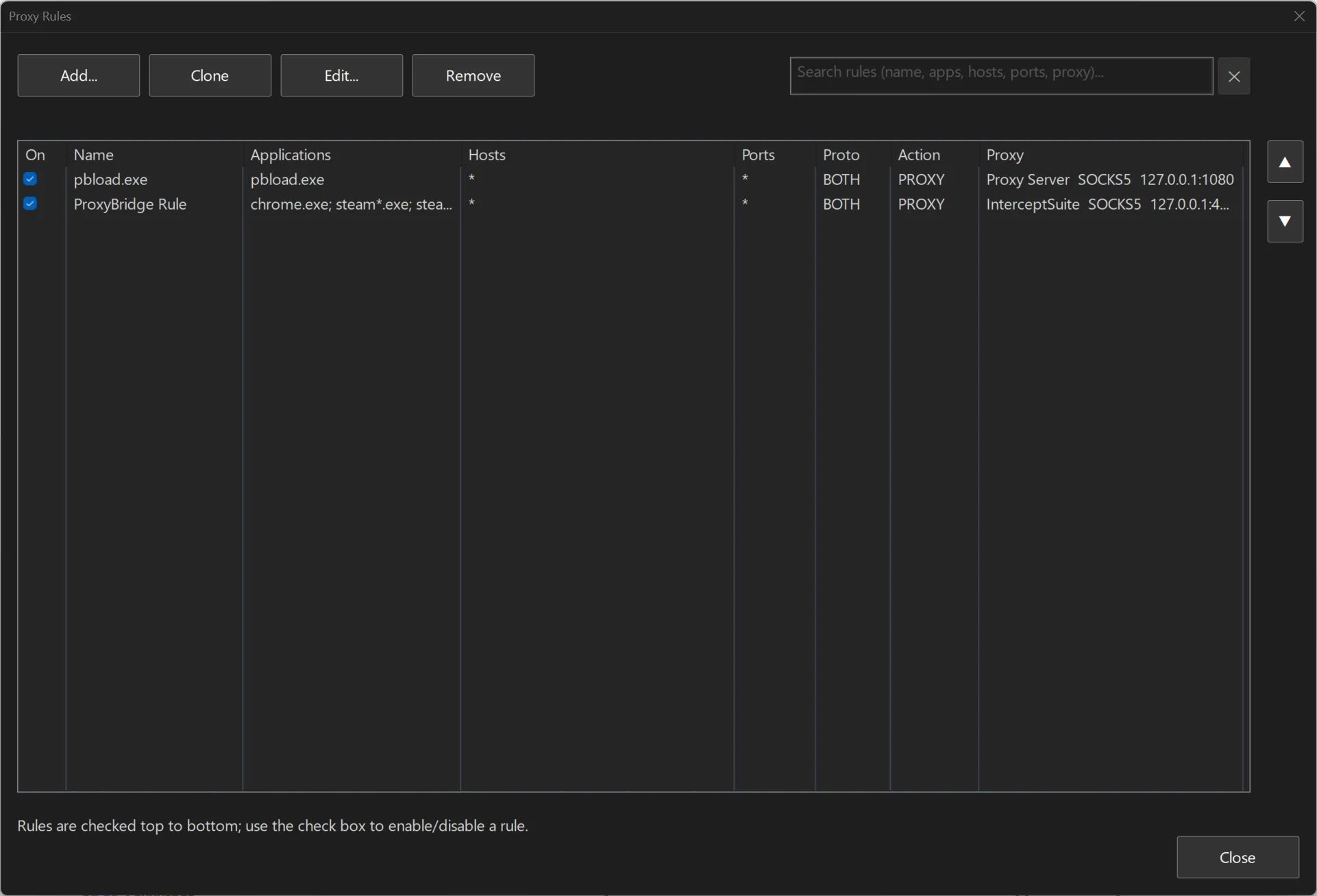
- Choose Proxy > Proxy Rules... and click Add...
- In Applications, type the program name, for example
curl.exe, or click Running... to pick it from the programs that are running now, or Browse... to pick the.exefrom disk. - Leave Target Hosts and Target Ports as
*to match everything this program does. - Set Action to your proxy (each proxy you added is listed by name).
- Click OK. The rule is active immediately, and the On check box lets you switch it off again.
Details for every field are on the Proxy rules page.
3. Check that it works
Start the application, then look at the main window:
- Connections tab: each new connection appears as one line, for example
curl.exe (PID:4120) -> 93.184.216.34:443 via Proxy SOCKS5://127.0.0.1:1080. A line ending in via Direct means no rule matched or the rule says Direct. - Live Connections tab: the connections that are open right now, with the rule and proxy used and the bytes sent and received.
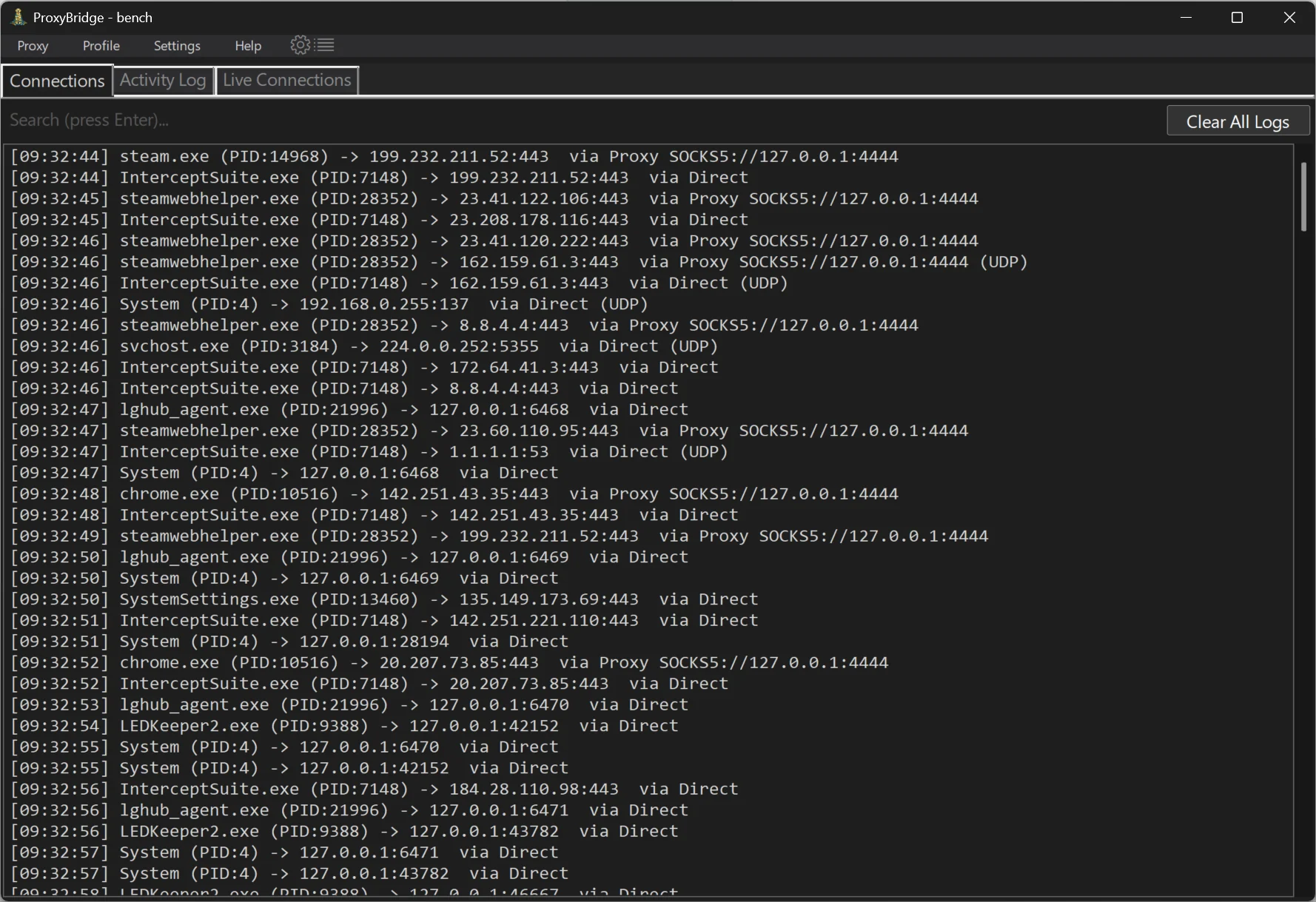
If nothing is listed as proxied, see Troubleshooting.
What is new in 4.3.0
| Feature | Where |
|---|---|
| Live Connections tab: open proxied connections with the rule and proxy used, and bytes sent and received | Connections, Live Connections and logs |
| Running... button in the rule editor: pick programs from the ones that are running | Proxy rules |
| Browse... accepts several files from different folders | Proxy rules |
| Log Every Connection setting | Connections, Live Connections and logs |
IPv4 CIDR in Target Hosts (10.0.0.0/8) |
Proxy rules |
| Up to 32 proxy servers (was 16) | Proxy servers |
| A longer Applications field (hundreds of programs per rule) | Proxy rules |
Check your version with Help > About. To update, see Install on Windows.
The Windows guide
| I want to... | Read |
|---|---|
| Add, edit and test proxy servers, use authentication, run several proxies | Proxy servers |
| Match applications, hosts, domains, ports and protocols; understand rule order | Proxy rules |
| Keep separate setups, move them between machines, share them with a team | Profiles |
| See what is going through ProxyBridge and filter the log | Connections, Live Connections and logs |
| Pause ProxyBridge, start it with Windows, use the tray icon, change language or text size | Settings, tray and pausing |
| Run a profile without the window | Command line (CLI) |
| See worked examples (browser, curl, games, security testing, ...) | Use cases and recipes |
| Fix a problem | Troubleshooting and limits |
| Understand what happens to a packet | How it works |
Good to know before you start
- First match wins. Rules are checked from top to bottom. A rule for
*(all applications) with no host or port filter is the exception: it is a catch-all that is only used when no other rule matched. See Proxy rules. - Localhost stays local by default. Connections to
127.0.0.1and::1are sent directly unless you tick Also proxy localhost traffic on the rule. - UDP needs SOCKS5. An HTTP proxy cannot carry UDP, and many SOCKS5 proxies do not support UDP either. See Troubleshooting and limits.
- Domain rules need plain DNS. Rules that match by hostname work only when the application uses ordinary, unencrypted DNS. Turn off "Secure DNS" in the browser for those.